Retool
Retool is a modern AI-native application development platform designed to help teams build internal software quickly and efficiently. It enables users to create agents, workflows, dashboards, and full-stack apps using natural language prompts and visual tools. Retool connects directly to databases, APIs, vector stores, and AI models to ensure applications work seamlessly with existing systems. The platform allows teams to transform raw data into actionable tools such as dashboards, admin panels, and monitoring systems. With drag-and-drop UI building, code-level customization, and AI-assisted generation, Retool supports multiple development styles. Built-in workflows automate complex processes while maintaining auditability and security. Retool fits naturally into standard engineering stacks with support for CI/CD and version control. Enterprise-grade permissions and hosting options ensure sensitive data stays protected. Used by thousands of companies worldwide, Retool helps teams ship AI-powered software faster. It bridges the gap between idea and production with speed and control.
Learn more
Google AI Studio
Google AI Studio is an all-in-one environment designed for building AI-first applications with Google’s latest models. It supports Gemini, Imagen, Veo, and Gemma, allowing developers to experiment across multiple modalities in one place. The platform emphasizes vibe coding, enabling users to describe what they want and let AI handle the technical heavy lifting. Developers can generate complete, production-ready apps using natural language instructions. One-click deployment makes it easy to move from prototype to live application. Google AI Studio includes a centralized dashboard for API keys, billing, and usage tracking. Detailed logs and rate-limit insights help teams operate efficiently. SDK support for Python, Node.js, and REST APIs ensures flexibility. Quickstart guides reduce onboarding time to minutes. Overall, Google AI Studio blends experimentation, vibe coding, and scalable production into a single workflow.
Learn more
Manus AI
Manus is a multifaceted general AI agent that effectively connects ideas with actions, allowing it to carry out various tasks in both work and personal environments. Whether it's handling data analysis, organizing travel itineraries, developing educational resources, or providing stock market insights, Manus empowers users to accomplish their goals while attending to other important matters. Its capabilities extend to conducting intricate research, crafting engaging presentations, and interpreting market dynamics, all aimed at enhancing productivity and streamlining efficiency. Furthermore, Manus produces precise, actionable insights, establishing itself as a vital resource for both professionals and everyday users aiming to simplify their workflows and achieve a greater understanding of their tasks. By integrating advanced technology with user-friendly functionality, Manus becomes an indispensable companion in navigating the complexities of modern life.
Manus Desktop with the “My Computer” capability allows an AI agent to work directly on a user’s local device, extending its functionality beyond cloud-based environments. It uses command line access to read, modify, and organize files, as well as launch and control local applications and tools. This enables users to automate time-consuming tasks such as sorting files, batch renaming documents, and managing workflows with minimal effort. The platform also supports advanced development capabilities, allowing the AI to build, debug, and deploy applications using local programming environments like Python, Node.js, and Swift. By bridging cloud intelligence with local system resources, it enhances productivity and unlocks new automation possibilities.
Learn more
MetaGPT
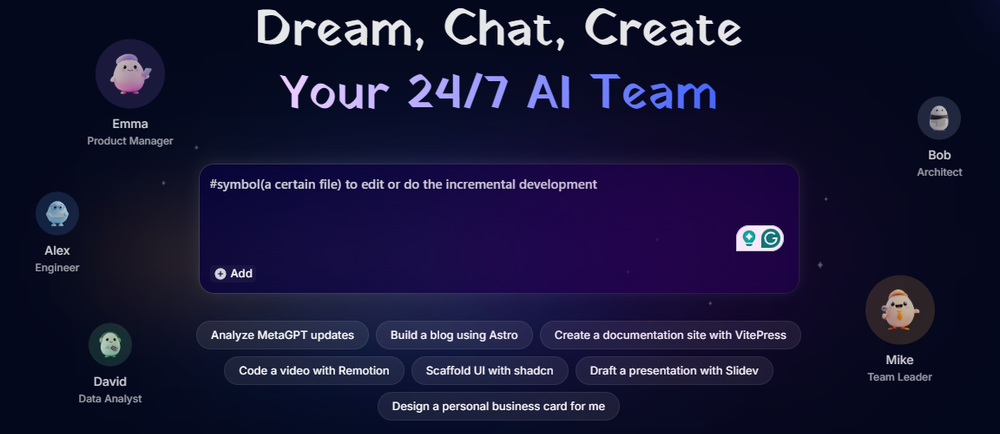
The Multi-Agent Framework allows for the transformation of a single line requirement into a comprehensive set of outputs including PRD, design specifications, tasks, and repository details. By assigning various roles to separate GPTs, a synergistic software entity is created that can tackle intricate projects effectively. MetaGPT processes a one-line requirement to generate user stories, competitive analyses, requirements, data structures, APIs, and documentation. Within its architecture, MetaGPT encompasses roles such as product managers, architects, project managers, and engineers, thereby facilitating the complete workflow of a software company with meticulously designed Standard Operating Procedures (SOPs). This integrated approach not only enhances collaboration but also streamlines the development process, ensuring that all aspects of software creation are covered efficiently.
Learn more